
Your next decision
deserves more than
a quick answer.

When work changes, a confident answer can be a relief. It can also leave out the responsibilities, hopes, and experience that make a decision yours. Here, you can take time to examine that answer and imagine another way forward.

Learning to Think, Create, and Thrive with AI.
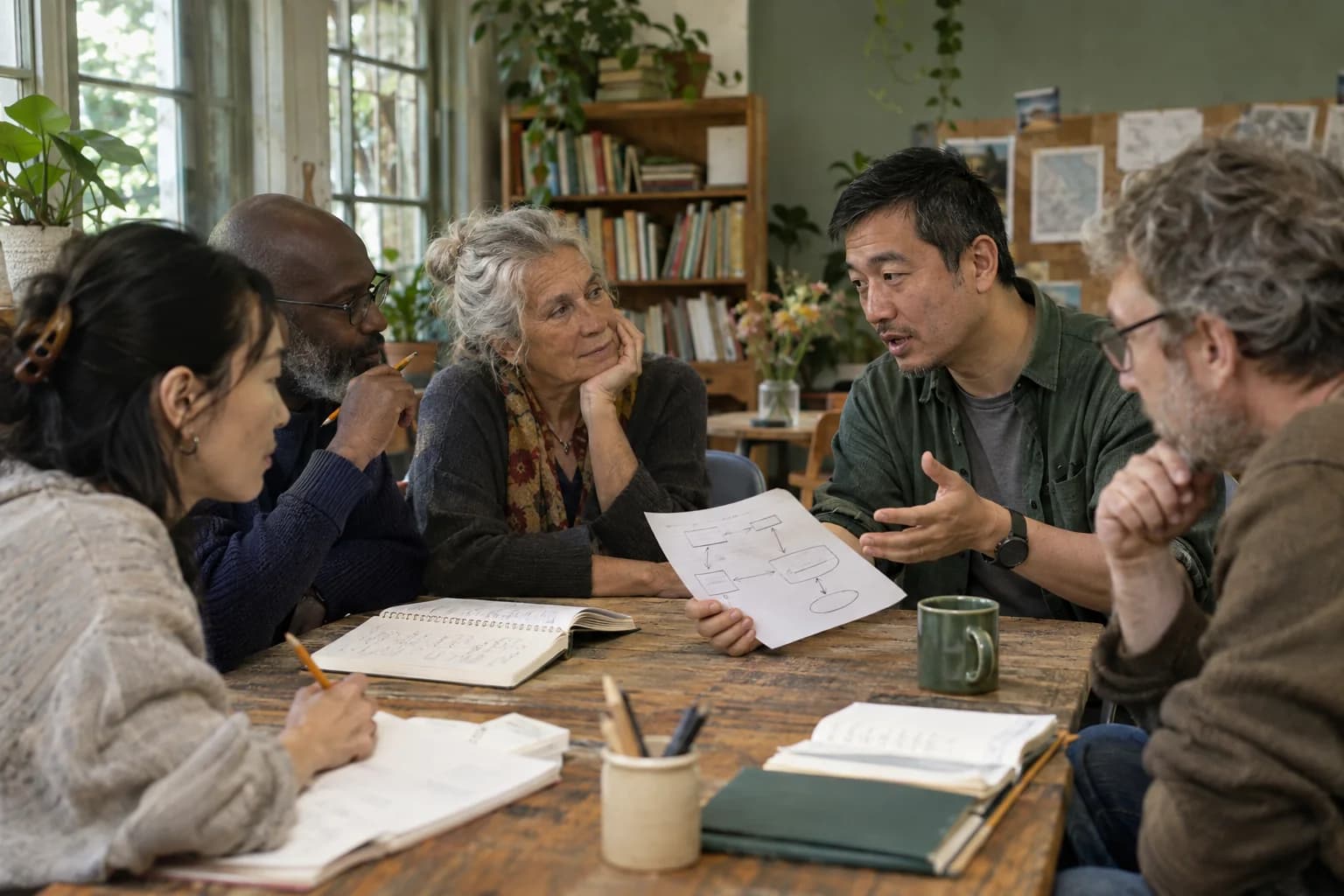
AI illustration of adults from different generations discussing a hand-drawn diagram around a table.
AI-generated illustrative imageFictional people and setting · not a record of actual events
A place for conversation

What would you do, and what might change your mind?

A research-informed learning platform for human judgment, creativity, and responsible AI use.

Independent project
Early-stage learning prototype

It is easier to notice a leap
when someone else has to land.

Lin needs a new direction. Nadia wants steadier work. Sofia owes her teachers a better conversation. Each has a reason to welcome AI’s advice, and a reason to look more closely.

Choose a story ↗

These are fictional educational cases. All characters, documents, and outcomes are invented; images are AI-generated illustrations, not actual participants or events.

You can change your mind.
You can also explain why you haven’t.

Begin with your own judgment, read the context, and decide what deserves a closer look. The story will still be there when you return to it with a different question.

AI illustration of three colleagues discussing a sketch beside a laptop in a shared workplace.
AI-generated illustrative imageFictional people and setting · not a record of actual events

The thinking is yours to do.

You can inspect a fictional source, question a persuasive claim, and draft two approaches that make different trade-offs. Later, your first response sits beside the judgment you would make now. Prepared explanations offer something to argue with; they do not grade your writing.

Each story moves through Connect, Explore, Challenge, Create, Reflect, and Transfer. You can revisit any stage and download a worksheet with your own notes. If you would prefer a shorter, guided comparison of an answer with its source, the original Practice module is a useful place to begin.

Try the Practice module →Enter a six-stage story →
Choose your next step

Begin where your question takes you.

You can enter a story, try a small writing task, or spend a moment with your own reasoning. None requires an AI account.

The WeAI philosophy

How we think matters
as much as what we produce.

Sound judgment, imagination, and care for other people rarely work in isolation. WeAI gives them three connected names, so we can notice what a task asks of us.

01 / USE AI

Smartly

Lin’s experience deserves recognition, even when a recommendation goes further than the evidence. Using AI smartly means knowing what an answer can contribute, which conditions matter, and when another source or person should enter the conversation.

Read about smartly →
02 / USE AI

Creatively

Nadia does not need an endless list of business ideas. She needs possibilities that make sense at her workbench. Using AI creatively means bringing lived experience into the brief, trying genuinely different approaches, and deciding what is worth making.

Read about creatively →
03 / USE AI

Responsibly

Sofia’s decision will affect people who did not choose the tool. Using AI responsibly means giving those people a voice, considering who carries the risks, and building a process that someone can question before it becomes routine.

Read about responsibly →
Knowing → Judgment → Action

Understanding a situation does not settle what to do. We weigh what we know against what matters, take a step, and learn from what happens. Constructive Critical Skepticism is our working name for questioning an answer in a way that helps this process move forward.

Follow the reasoning in the Learning Lab ↗

A thoughtful experience
still needs to be examined.

A learner can revise an answer without developing better judgment. They can enjoy a story without using its ideas elsewhere. The Learning Lab explains the design choices behind WeAI and the evidence a future study would need before we could claim that those choices support learning.

Read the Learning Lab ↗
Read more in Insights ↗

The questions follow us
through working lives.

A university seminar, a conversation about retraining, and a leadership meeting may have little in common on the surface. In each, someone has to decide what an answer means, whose experience it overlooks, and what to do with the uncertainty that remains.

These stories could become starting points for adult education, workforce transitions, organisational learning, or executive education. Each setting would need its own language, facilitation, and review. WeAI is a working prototype; those possibilities are questions for future collaboration and evaluation, not established programmes or evidence of impact.

Read the research framework →Consider adaptation across settings →
AI illustration of an older woman and a younger man exchanging ideas over a notebook in a library.
AI-generated illustrative imageFictional people and setting · not a record of actual events