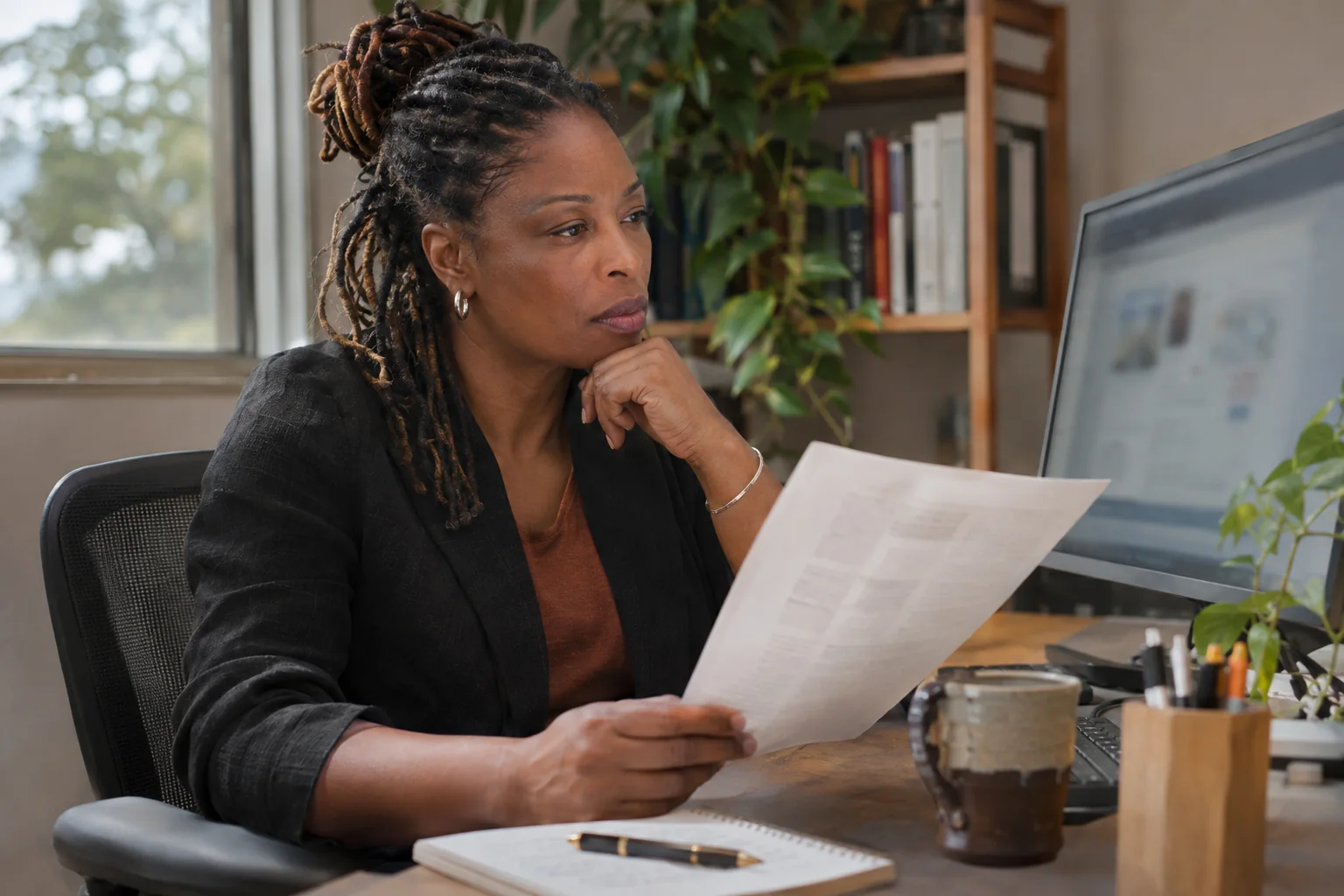
Imagine that a colleague has asked for a short explanation before tomorrow’s meeting. You understand the subject well enough to know it matters, but not well enough to write quickly. An AI assistant returns a paragraph that seems to find the centre of the problem. You read it twice, change a few words, and feel a small, welcome sense of relief.
Then a sentence catches your attention. The answer says that an approach improved learning. The source you supplied said that people felt more confident. You could leave the distinction for later. The meeting is tomorrow, after all, and the paragraph is otherwise useful. Or you could pause over what those words would ask your colleagues to believe.
This is a hypothetical situation, not a report of an actual incident. It matters because the answer does not have to be wholly wrong to carry a decision in the wrong direction. A useful draft can contain one unjustified step, and that step can be the part we most want to keep.
A clear explanation can hide an uncertain step
Fluency makes reading easier. It does not establish that the claims are accurate. A text-generating AI system can offer a coherent explanation while inventing a detail, misreading a source, or presenting a possibility as a conclusion. Some of these failures are described as hallucinations; others are quieter changes of emphasis that do not require an invented fact.
Think about the difference between saying a training programme was followed by higher confidence and saying it caused better performance. The second sentence asks the evidence to do more work. It changes the outcome, introduces a causal explanation, and may invite a stronger recommendation. Each change could pass unnoticed when the prose moves smoothly towards a conclusion.
What would someone need to know before this sentence deserved their trust?
The answer is not to make every sentence timid. It is to keep the relationship between a claim and its basis visible. A confident statement can be warranted. A cautious-sounding sentence can still be misleading. What matters is what the source permits us to say, in this setting, for the purpose at hand.
A useful place to begin
Choose a sentence that would matter if it were wrong. In a summary, that may be the conclusion rather than a minor detail. In a plan, it may be a current requirement or a deadline that needs checking with the organisation responsible. In an explanation, it may be the point where a description turns into advice. You do not need to investigate every word equally to make a more careful decision.
Which words change what the evidence means?
This source and AI-style response are invented for learning. They are not a real study or a record of an AI conversation.
In a one-week classroom comparison, students chose either an AI study guide or their usual notes. AI-guide users reported greater confidence. Average comprehension scores were similar. There was no later follow-up.
Select a sentence to examine how its claim relates to the source. Consider what you would preserve if you rewrote it.
Before accepting the conclusion Choose a sentence and compare what it asks you to believe with what the source actually reports.
Read a more careful version
In this fictional one-week comparison, AI-guide users reported greater confidence, but comprehension scores were similar. Because students chose their groups and there was no follow-up, the comparison does not establish a learning benefit or a lasting effect.
Keep the question open without leaving the decision unfinished
In the example, a reader can reasonably say that the source does not justify a claim. That does not establish that the claim is false in every setting. A short classroom comparison cannot settle everything we might want to know about study guides. Recognising its limits gives us a better next question: what evidence would be needed for the decision we are actually considering?
Sometimes the next step is to open the original material, check what was measured, and revise the wording. Sometimes it is to ask a person with relevant expertise or look for a source that addresses the missing question. Asking the same assistant whether it is sure may produce a more cautious answer, but it does not provide an independent check.
A citation is a lead, not the end of the work. Confirm that the source exists, read the relevant passage, and consider whether it supports the particular sentence you plan to share. If the decision is consequential and you cannot complete the check, make that limitation part of the conversation rather than quietly passing the uncertainty to someone else.
There is also a point at which checking becomes avoidance. The useful question is which uncertainty could change the next step. You might be able to send a corrected summary today while reserving a larger recommendation until better evidence is available. Responsible action often means reducing a commitment, rather than choosing between immediate certainty and doing nothing.
What changes when the audience changes?
Use the fictional source above to write a one-sentence summary, a short message to a colleague, and a question for a classroom discussion. You can work on paper, in your own notes, or with an AI tool. The facts stay the same, but what each audience needs from you will differ.
As you compare the versions, notice whether the distinction between confidence and comprehension survives. Try to retain a meaningful limitation without burying the main point. Decide what you have left out and whether the omission could lead someone to draw a stronger conclusion than the source supports.
If an AI assistant helps, ask it to preserve those conditions. Then read its drafts as someone accountable for the explanation. The most polished version may not be the most faithful one.
Read about purposeful exploration →Which part would you have wanted to believe?
Consider a time when an explanation felt persuasive because it made a difficult task easier. In the example above, which claim would you have been most tempted to keep, and what would you need to check before sharing it? Your answer can include a reason to retain useful material as well as a reason to revise it.
Optional. This note stays in page memory and clears when you leave or refresh. It is not submitted or graded.
Before the answer leaves your desk
Checking is easier to repeat when it becomes part of a specific task. Before sharing your next AI-assisted explanation, use these questions to decide what needs attention.
Choose a sentence whose accuracy matters. A useful check begins with something more precise than whether the whole answer feels trustworthy.
Compare the sentence with the source, including the setting, time frame, and what was actually observed. Keep separate what the material says and what you infer.
Preserve the qualification a reader needs in order to use the answer sensibly. Clear writing can make uncertainty understandable without pretending it has disappeared.
The greater the consequences, the stronger the basis for acting should be. Use appropriate authoritative information and qualified advice where the decision requires it.
The paragraph you finally send may be shorter and less reassuring than the first draft. It may also leave your colleagues better able to decide. That is a useful kind of help to offer.
What would you do with this summary?
The original Practice module gives you a fictional source, an AI-style answer, and a recommendation to consider. Explain your judgment before comparing it with prepared feedback.
Try the Practice module →Consider who is affected →